pro $24.99 per month
- access to all Manning books, MEAPs, liveVideos, liveProjects, and audiobooks!
- choose one free eBook per month to keep
- exclusive 50% discount on all purchases
- renews monthly, pause or cancel renewal anytime
lite $19.99 per month
- access to all Manning books, including MEAPs!
team
5, 10 or 20 seats+ for your team - learn more
Look inside
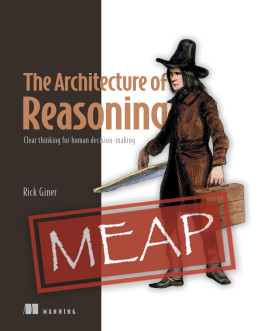
AI models “reason” by applying specific, reproducible patterns to break down tasks, solve multi-step problems, and produce complex documents, images, and code. In The Architecture of Reasoning, author Rick Giner examines these reasoning patterns and shows how you can apply them to make better decisions and work more effectively—even in tasks and interactions that do not involve AI.
You’ll begin by identifying the five reasoning structures revealed through AI research: Direct Q&A for bounded problems, Chain-of-Thought for surfacing hidden assumptions, Tree-of-Thought for genuine exploration, Chair-of-Thought for rotating perspectives, and ReAct for looping between reasoning and evidence. Then, you’ll see how each can be applied in your personal and team work. You’ll learn to match the reasoning pattern to the task at hand and choose the most efficient architecture to get the results you want.
Each reasoning pattern you’ll explore is grounded in familiar situations, from the team that leaves the same meeting optimizing for three different outcomes, to the AI rollout that improves every metric except the one that actually mattered. You’ll learn to recognize reasoning compression, diagnose the shape of a problem, expand the solution space without descending into brainstorming chaos, and turn conclusions into testable hypotheses. Plus, you’ll develop the ability to design documents, reviews, and workflows as reasoning systems, removing the need for an expert on hand to rescue you from poor decision processes.
Even the most carefully structured reasoning process can fail in the wrong environment. The Architecture of Reasoning explores how attention, status, tempo, evidence quality, and psychological conditions shape how people reason, and gives you the cognitive infrastructure you can use to help good ideas survive contact with organizational pressure. Throughout the book you’ll find compact tools such as the 60-second problem-shape check, reasoning-selection tables, and Chain-of-Thought scaffolds that help you make better decisions, fast.
what's inside
- Identifying and reshaping reasoning structures in conversation
- AI reasoning architectures adapted for human decisions
- Applying cognitive infrastructure like attention and airtime
- The principle of smallest sufficient architecture
about the reader
This book is for engineering managers, CTOs, staff engineers, product leaders, executives, and anyone responsible for the quality of decisions.about the author
Rick Giner is a software engineering leader and consultant with 25 years of experience running SaaS businesses, advising technology teams and coaching leaders. He’s helped transform the ways of working of hundreds of teams across Europe and Australia with his people and product-focused approach, and is a regular speaker on the international conference scene covering topics including leadership, communication, accessibility, software engineering and AI.
related titles
related titles








choose your plan
pro
monthly
annual
$24.99
$249.99
only $20.83 per month
- access to all Manning books, MEAPs, liveVideos, liveProjects, and audiobooks!
- choose another free product every time you renew
- choose twelve free products per year
- exclusive 50% discount on all purchases
- renews monthly, pause or cancel renewal anytime
- renews annually, pause or cancel renewal anytime
-
![]() The Architecture of Reasoning ebook for free
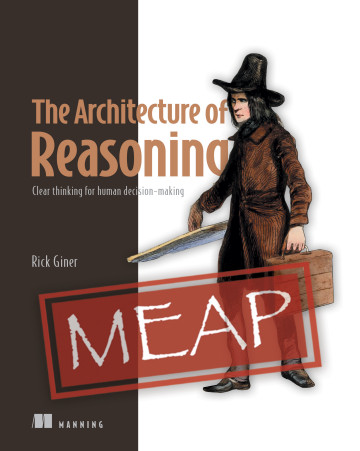 The Architecture of Reasoning ebook for free
team
monthly
annual
$49.99
$499.99
only $41.67 per month
- five seats for your team
- access to all Manning books, MEAPs, liveVideos, liveProjects, and audiobooks!
- choose another free product every time you renew
- choose twelve free products per year
- exclusive 50% discount on all purchases
- renews monthly, pause or cancel renewal anytime
- renews annually, pause or cancel renewal anytime
-
![]() The Architecture of Reasoning ebook for free
choose your plan
pro
monthly
annual
$24.99
$249.99
only $20.83 per month
- access to all Manning books, MEAPs, liveVideos, liveProjects, and audiobooks!
- choose another free product every time you renew
- choose twelve free products per year
- exclusive 50% discount on all purchases
- renews monthly, pause or cancel renewal anytime
- renews annually, pause or cancel renewal anytime
-
![]() The Architecture of Reasoning ebook for free
team
monthly
annual
$49.99
$499.99
only $41.67 per month
- five seats for your team
- access to all Manning books, MEAPs, liveVideos, liveProjects, and audiobooks!
- choose another free product every time you renew
- choose twelve free products per year
- exclusive 50% discount on all purchases
- renews monthly, pause or cancel renewal anytime
- renews annually, pause or cancel renewal anytime
-
![]() The Architecture of Reasoning ebook for free
