

pro $24.99 per month
- access to all Manning books, MEAPs, liveVideos, liveProjects, and audiobooks!
- choose one free eBook per month to keep
- exclusive 50% discount on all purchases
- renews monthly, pause or cancel renewal anytime
lite $19.99 per month
- access to all Manning books, including MEAPs!
team
5, 10 or 20 seats+ for your team - learn more
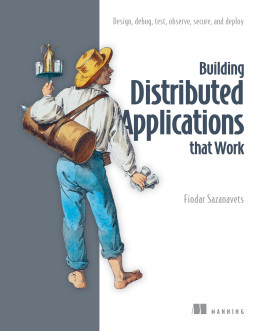
Look inside
"Connects the developer experience to the real problems of distributed applications: configuration, dependencies, debugging, testing, and deployment.”
—Scott Hanselman, Microsoft
Systems that are split into independent, network-connected services, whatever their benefits, can be difficult to design, deploy, and maintain. In Building Distributed Applications that Work, author Fiodar Sazanavets shows you how to conquer the inevitable communication failures, complex startup dependencies, and fragmented diagnostic data using industry-grade architectural patterns. Written for busy builders and software shippers, this book sticks to the techniques you’ll actually need—all demonstrated with examples using the .NET Aspire framework. Practical from the very start, this book gives you the tools and techniques to have a real project up and running by the end of the first chapter!
Building Distributed Applications that Work introduces a realistic e-commerce application that provides a clear, step-by-step progression through essential cloud-native concepts. You’ll start by mastering local orchestration and service discovery to establish clean service boundaries. Then, you’ll make your system resilient and scalable by externalizing state into relational databases, document stores, and cloud-native blobs. This hands-on journey helps you learn how to handle real-world system evolution cleanly rather than studying isolated code snippets or simplified, abstract configurations.
As your distributed system grows, you’ll add other elements from the Aspire ecosystem, including interactive SignalR tracking and local AI capabilities. Reviewer Rob Ruetsch of Little Bird GmbH praised the “forward-leaning” examples, commenting, “Very realistic. I love that MCP and agents were discussed in chapter 10!” You will host local language models using Ollama and build autonomous, tool-calling AI agents. This modern approach to intelligent systems ensures you can safely build smart, responsive applications that are fully prepared for next-generation enterprise workloads.
Because graceful failure is mandatory for distributed systems, you’ll explore asynchronous message queues, distributed locking, and end-to-end token security. Reviewer David Sellen of Sweet Systems pointed out that “even for simple applications, visibility into logs, traces, and metrics is essential, and this book is a great introduction to observability!” By learning to construct robust integration tests, configure Open-Telemetry, and secure microservices via OIDC and JWT token propagation, you ensure your applications are resilient, highly observable, and production-ready. As you build your distributed application in Aspire, author Fiodar Sazanavets carefully expands each concept so you can reproduce it in your framework of choice.
For .NET developers, this book is a practical guide to Aspire’s dashboard, AppHost, and service defaults. Developers and DevOps practitioners from other ecosystems will also gain transferable insight into orchestrating, observing, testing, and deploying multi-service applications—though the hands-on examples use .NET and Aspire.
—Scott Hanselman, Microsoft
Systems that are split into independent, network-connected services, whatever their benefits, can be difficult to design, deploy, and maintain. In Building Distributed Applications that Work, author Fiodar Sazanavets shows you how to conquer the inevitable communication failures, complex startup dependencies, and fragmented diagnostic data using industry-grade architectural patterns. Written for busy builders and software shippers, this book sticks to the techniques you’ll actually need—all demonstrated with examples using the .NET Aspire framework. Practical from the very start, this book gives you the tools and techniques to have a real project up and running by the end of the first chapter!
Building Distributed Applications that Work introduces a realistic e-commerce application that provides a clear, step-by-step progression through essential cloud-native concepts. You’ll start by mastering local orchestration and service discovery to establish clean service boundaries. Then, you’ll make your system resilient and scalable by externalizing state into relational databases, document stores, and cloud-native blobs. This hands-on journey helps you learn how to handle real-world system evolution cleanly rather than studying isolated code snippets or simplified, abstract configurations.
As your distributed system grows, you’ll add other elements from the Aspire ecosystem, including interactive SignalR tracking and local AI capabilities. Reviewer Rob Ruetsch of Little Bird GmbH praised the “forward-leaning” examples, commenting, “Very realistic. I love that MCP and agents were discussed in chapter 10!” You will host local language models using Ollama and build autonomous, tool-calling AI agents. This modern approach to intelligent systems ensures you can safely build smart, responsive applications that are fully prepared for next-generation enterprise workloads.
Because graceful failure is mandatory for distributed systems, you’ll explore asynchronous message queues, distributed locking, and end-to-end token security. Reviewer David Sellen of Sweet Systems pointed out that “even for simple applications, visibility into logs, traces, and metrics is essential, and this book is a great introduction to observability!” By learning to construct robust integration tests, configure Open-Telemetry, and secure microservices via OIDC and JWT token propagation, you ensure your applications are resilient, highly observable, and production-ready. As you build your distributed application in Aspire, author Fiodar Sazanavets carefully expands each concept so you can reproduce it in your framework of choice.
For .NET developers, this book is a practical guide to Aspire’s dashboard, AppHost, and service defaults. Developers and DevOps practitioners from other ecosystems will also gain transferable insight into orchestrating, observing, testing, and deploying multi-service applications—though the hands-on examples use .NET and Aspire.
what's inside
- Code-first microservices orchestration
- OpenTelemetry distributed tracing and structured logging
- Securing cross-service communications with Keycloak, OIDC, and JWTs
- Deploying containerized workflows to Kubernetes and Azure
- Examples use the .NET Aspire framework
about the reader
This book is designed for mid-career software engineers, architects, and DevOps professionals seeking hands-on patterns to build, observe, and deploy resilient distributed systems.
related titles
related titles


choose your plan
pro
monthly
annual
$24.99
$249.99
only $20.83 per month
- access to all Manning books, MEAPs, liveVideos, liveProjects, and audiobooks!
- choose another free product every time you renew
- choose twelve free products per year
- exclusive 50% discount on all purchases
- renews monthly, pause or cancel renewal anytime
- renews annually, pause or cancel renewal anytime
-
![]() Building Distributed Applications that Work ebook for free
Building Distributed Applications that Work ebook for free
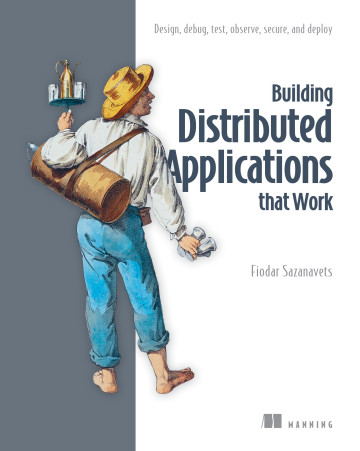 Building Distributed Applications that Work ebook for free
team
monthly
annual
$49.99
$499.99
only $41.67 per month
- five seats for your team
- access to all Manning books, MEAPs, liveVideos, liveProjects, and audiobooks!
- choose another free product every time you renew
- choose twelve free products per year
- exclusive 50% discount on all purchases
- renews monthly, pause or cancel renewal anytime
- renews annually, pause or cancel renewal anytime
-
![]() Building Distributed Applications that Work ebook for free
Building Distributed Applications that Work ebook for free
choose your plan
pro
monthly
annual
$24.99
$249.99
only $20.83 per month
- access to all Manning books, MEAPs, liveVideos, liveProjects, and audiobooks!
- choose another free product every time you renew
- choose twelve free products per year
- exclusive 50% discount on all purchases
- renews monthly, pause or cancel renewal anytime
- renews annually, pause or cancel renewal anytime
-
![]() Building Distributed Applications that Work ebook for free
Building Distributed Applications that Work ebook for free
team
monthly
annual
$49.99
$499.99
only $41.67 per month
- five seats for your team
- access to all Manning books, MEAPs, liveVideos, liveProjects, and audiobooks!
- choose another free product every time you renew
- choose twelve free products per year
- exclusive 50% discount on all purchases
- renews monthly, pause or cancel renewal anytime
- renews annually, pause or cancel renewal anytime
-
![]() Building Distributed Applications that Work ebook for free
Building Distributed Applications that Work ebook for free
