pro $24.99 per month
- access to all Manning books, MEAPs, liveVideos, liveProjects, and audiobooks!
- choose one free eBook per month to keep
- exclusive 50% discount on all purchases
- renews monthly, pause or cancel renewal anytime
lite $19.99 per month
- access to all Manning books, including MEAPs!
team
5, 10 or 20 seats+ for your team - learn more
"A wonderful, modern security book for developers.”
—Jeanne Boyarsky, Java Champion
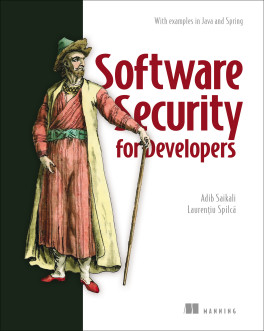
Software security is about understanding how real systems fail, and how to build them so they don’t. Software Security for Developers gives you that understanding, and shows you how to apply it in the modern cloud and Kubernetes environments you work with every day.
The book starts with the reality developers face: security problems are not theoretical—they show up in design choices, dependencies, configuration, and day-to-day coding decisions. You’ll see why breaches happen, how supply chain risks creep in, and how “secure development” actually looks across the lifecycle—from design to deployment.
From there, the book builds the foundation you need to work confidently with security tools. Instead of treating frameworks as black boxes, it explains the standards, protocols, and patterns they implement.
You’ll learn how integrity, encryption, authentication, and identity really work—so TLS, OAuth2, OpenID Connect, and certificates become understandable and usable.
With that foundation in place, the focus shifts to modern application architecture. You’ll implement secure communication channels, design authentication and identity flows, adopt passwordless approaches, and manage authorization across complex service-to-service call chains. Along the way, you’ll see how to give every service an identity, enforce access policies, and secure interactions in distributed, cloud-native systems.
Throughout the book, concepts are grounded in practical Java examples that mirror real production scenarios. By the end, you’ll be familiar with security terms and know how to apply them to build systems that pass audits, resist attacks, and hold up under real-world pressure.
—Jeanne Boyarsky, Java Champion
Software security is about understanding how real systems fail, and how to build them so they don’t. Software Security for Developers gives you that understanding, and shows you how to apply it in the modern cloud and Kubernetes environments you work with every day.
The book starts with the reality developers face: security problems are not theoretical—they show up in design choices, dependencies, configuration, and day-to-day coding decisions. You’ll see why breaches happen, how supply chain risks creep in, and how “secure development” actually looks across the lifecycle—from design to deployment.
From there, the book builds the foundation you need to work confidently with security tools. Instead of treating frameworks as black boxes, it explains the standards, protocols, and patterns they implement.
You’ll learn how integrity, encryption, authentication, and identity really work—so TLS, OAuth2, OpenID Connect, and certificates become understandable and usable.
With that foundation in place, the focus shifts to modern application architecture. You’ll implement secure communication channels, design authentication and identity flows, adopt passwordless approaches, and manage authorization across complex service-to-service call chains. Along the way, you’ll see how to give every service an identity, enforce access policies, and secure interactions in distributed, cloud-native systems.
Throughout the book, concepts are grounded in practical Java examples that mirror real production scenarios. By the end, you’ll be familiar with security terms and know how to apply them to build systems that pass audits, resist attacks, and hold up under real-world pressure.
what's inside
- Why security failures happen in real systems
- How to apply cryptography and security standards correctly
- How to secure identity, access, and service communication
about the authors
Adib Saikali is a Distinguished Software Engineer and a Principal Solutions Engineer at VMware Tanzu. Laurentiu Spilca is Java and Spring expert, an experienced technology instructor, and the author of several books.concepts explained in this book
- A public key is the openly distributable key in an asymmetric cryptographic pair, used for operations such as encrypting data or verifying signatures.
- An API key is a credential, usually represented as a string or token, presented with API requests to identify or authenticate a client and potentially authorize access.
- A public-private key pair consists of mathematically related public and private cryptographic keys used together for asymmetric cryptographic operations.
- Galois/Counter Mode is an authenticated-encryption mode that combines counter-mode encryption with authentication of ciphertext and associated data.
- Relationship-based access control is an authorization technique that makes decisions from defined relationships among principals, resources, groups, and other entities.
- OpenID Connect is an identity layer built on OAuth 2.0 that enables clients to authenticate end users and obtain standardized identity claims.
- Single sign-on is an authentication arrangement in which one authentication event enables a user to access multiple applications or services without signing in separately to each.
- A private key is secret cryptographic key material associated with a corresponding public key and used for operations such as signing or decryption.
Takes you by hand through all the major application security concepts, best practices and approaches.
A great resource to understand security principles as they apply to application development.
Clear, practical, and well-organized.
A modern update on application-layer security, accessible to both beginners and experienced cybersecurity developers.
A great book to become a security-aware, safe-and-sound application developer.
related titles
related titles




choose your plan
pro
monthly
annual
$24.99
$249.99
only $20.83 per month
- access to all Manning books, MEAPs, liveVideos, liveProjects, and audiobooks!
- choose another free product every time you renew
- choose twelve free products per year
- exclusive 50% discount on all purchases
- renews monthly, pause or cancel renewal anytime
- renews annually, pause or cancel renewal anytime
-
![Software Security for Developers]() Software Security for Developers ebook for free
 Software Security for Developers ebook for free
team
monthly
annual
$49.99
$499.99
only $41.67 per month
- five seats for your team
- access to all Manning books, MEAPs, liveVideos, liveProjects, and audiobooks!
- choose another free product every time you renew
- choose twelve free products per year
- exclusive 50% discount on all purchases
- renews monthly, pause or cancel renewal anytime
- renews annually, pause or cancel renewal anytime
-
![Software Security for Developers]() Software Security for Developers ebook for free
choose your plan
pro
monthly
annual
$24.99
$249.99
only $20.83 per month
- access to all Manning books, MEAPs, liveVideos, liveProjects, and audiobooks!
- choose another free product every time you renew
- choose twelve free products per year
- exclusive 50% discount on all purchases
- renews monthly, pause or cancel renewal anytime
- renews annually, pause or cancel renewal anytime
-
![Software Security for Developers]() Software Security for Developers ebook for free
team
monthly
annual
$49.99
$499.99
only $41.67 per month
- five seats for your team
- access to all Manning books, MEAPs, liveVideos, liveProjects, and audiobooks!
- choose another free product every time you renew
- choose twelve free products per year
- exclusive 50% discount on all purchases
- renews monthly, pause or cancel renewal anytime
- renews annually, pause or cancel renewal anytime
-
![Software Security for Developers]() Software Security for Developers ebook for free
choose your plan
pro
monthly
annual
$24.99
$249.99
only $20.83 per month
- access to all Manning books, MEAPs, liveVideos, liveProjects, and audiobooks!
- choose another free product every time you renew
- choose twelve free products per year
- exclusive 50% discount on all purchases
- renews monthly, pause or cancel renewal anytime
- renews annually, pause or cancel renewal anytime
-
![Software Security for Developers]() Software Security for Developers ebook for free
team
monthly
annual
$49.99
$499.99
only $41.67 per month
- five seats for your team
- access to all Manning books, MEAPs, liveVideos, liveProjects, and audiobooks!
- choose another free product every time you renew
- choose twelve free products per year
- exclusive 50% discount on all purchases
- renews monthly, pause or cancel renewal anytime
- renews annually, pause or cancel renewal anytime
-
![Software Security for Developers]() Software Security for Developers ebook for free
